ThingsX IoT Core
One device cloud for every kind of device, with LoRaWAN built in.
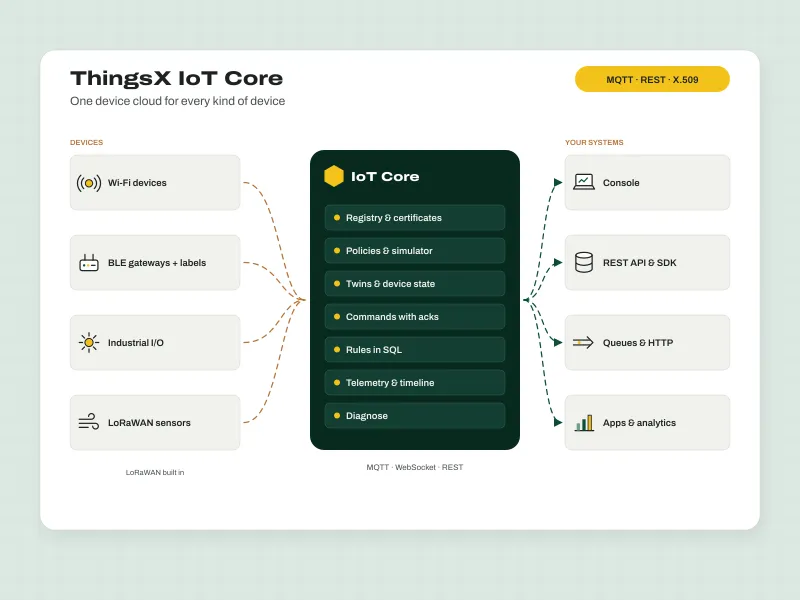
ThingsX IoT Core connects your devices securely, keeps track of every one of them, and routes data to your applications. Wi-Fi devices, in-store gateways, shelf labels, sensors, industrial I/O, and LoRaWAN devices live in one registry with shared certificates, policies, twins, commands, and rules. It is built for team operations. Every refused connection and denied message carries a clear reason. Every device has a Diagnose tab with a health score and a plain-word fix. Support staff can locate any device and copy a ticket-ready summary in one search. Moving from AWS, Azure, or your own MQTT server is a mapping exercise while devices keep their certificates. Deploy as a managed service or in your cloud.
What it does
- One registry for Wi-Fi devices, gateway children, industrial I/O, and LoRaWAN
- X.509 certificates or passwords over TLS; private keys shown once, never stored
- Least-privilege JSON policies with an integrated simulator
- Device twins with desired state, reported state, and delta
- Commands stored, retried, and acknowledged automatically
- Rules in SQL with a test bench and replayable failures
- Diagnose, timeline, and event log with reasons for every refusal
- IT support and customer lookup pages for support teams
Used for
- Moving a fleet off a cloud IoT service or your own MQTT server
- LoRaWAN sensor networks across large sites
- Cold-chain and facility monitoring across many stores
- Retail IoT with ThingsX gateways and labels
Key facts
What is ThingsX IoT Core?
A device cloud for every kind of device: it connects devices securely, keeps a registry of every one and routes their data to your applications. A drop-in alternative to AWS IoT Core, Azure IoT Hub or a self-run MQTT server, with LoRaWAN built in.
| Devices | Wi-Fi devices, gateway children (labels, sensors), industrial I/O and LoRaWAN, in one registry |
|---|---|
| Security | X.509 certificates or passwords over TLS; private keys shown once, never stored |
| Access control | Least-privilege JSON policies, with a simulator |
| State | Device twins with desired and reported state and the delta |
| Commands | Stored, retried and acknowledged |
| Rules | SQL rules with a test bench and replayable failures |
| Support | Diagnose tab with a health score, timeline, event log and a reason for every refusal |
| Migration | From AWS IoT Core, Azure IoT Hub or your own MQTT server; devices keep their certificates |
| Deployment | Managed service or your own cloud |
| Made by | Intellobots Technologies, Hyderabad, India |
How it works
From first device to fixed problem
- 1
Connect a device
Get started creates the thing, its certificate or password, a least-privilege policy and ready-to-run code.
- 2
Messages flow in
Telemetry, events and twin updates over MQTT or WebSocket, from devices, gateways and LoRaWAN sensors.
- 3
Rules act on them
Filter with SQL; republish, call your API, queue, update a twin or send a command.
- 4
Your apps use the data
REST API, SDK and webhooks, with the same names your team already knows.
- 5
Support fixes problems fast
Diagnose, timelines and reasons for every refusal; issues open and close by themselves.
Inside the console
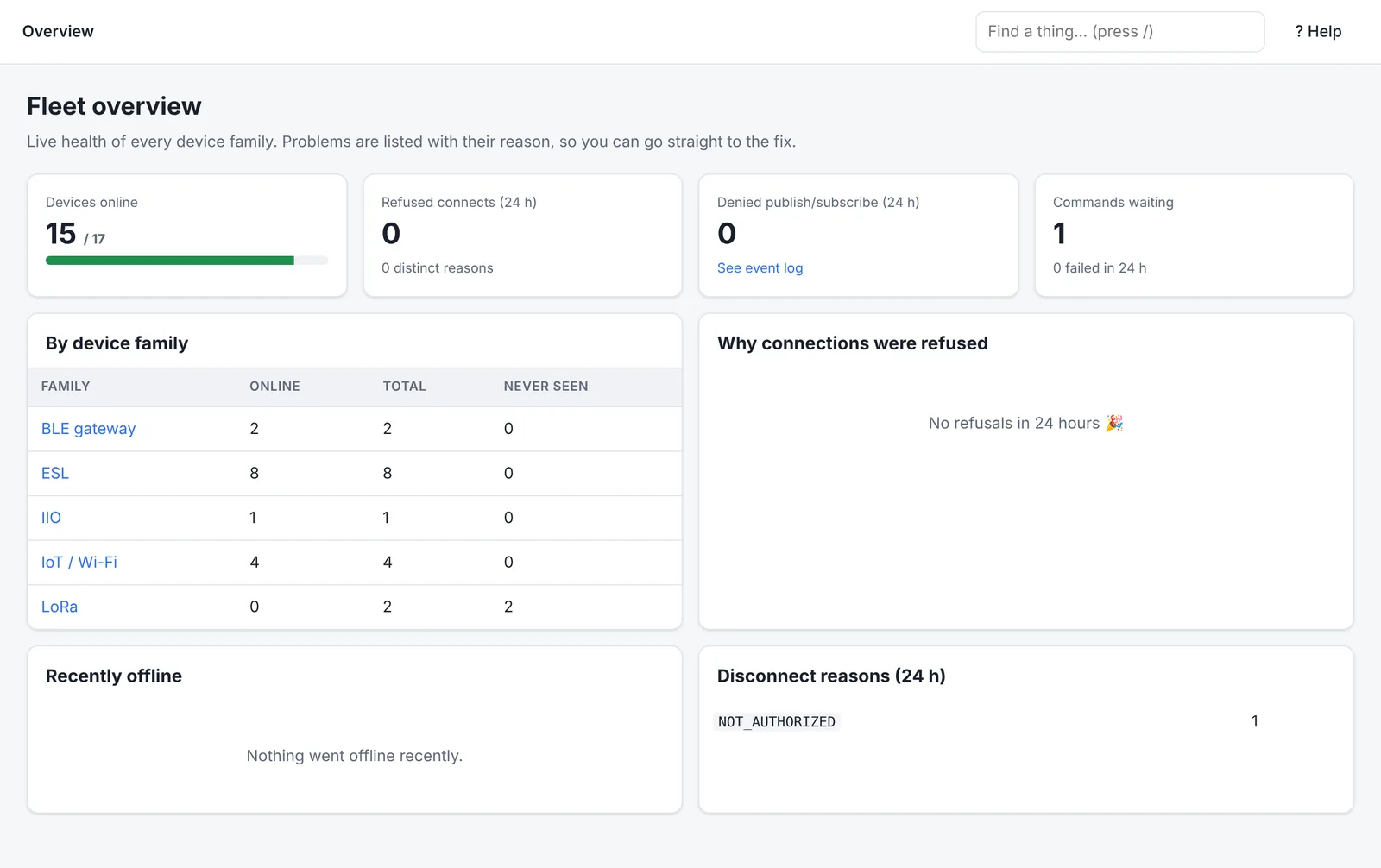
Built for the people who fix things
Real screens with demo devices. Pick one to see it larger.
Help & docs
Set it up, move to it, fix it
Guides written by the team that builds and supports ThingsX IoT Core.
All ThingsX IoT Core docs →- Get startedWhat ThingsX IoT Core doesOne device cloud for Wi-Fi devices, BLE gateways with shelf labels, industrial I/O and LoRaWAN sensors, with a console built for fixing problems fast.
- Get startedQuick start: connect your first deviceFrom your new workspace to live telemetry in about ten minutes, using the Get started wizard.
- Set upConnect Wi-Fi and IoT devicesEndpoints, topics and message formats for devices that talk MQTT directly, including commands and twins.
- Set upBLE gateways, shelf labels and child devicesConnect a BLE gateway once, and track every shelf label or sensor behind it as its own device.
- Set upLoRaWAN sensors and gatewaysAdd LoRa sensors with their DevEUI and AppKey, point your gateways at your workspace, and use uplinks and downlinks like any other device.
- Set upIndustrial I/O modulesConnect PLC and I/O modules directly or behind a gateway, and use their readings in rules.
Already on a cloud IoT service?
Familiar concepts, so nothing is relearned or re-flashed
Whether you run on AWS, Azure or another platform today, the building blocks are the same. Here is where each one lives in ThingsX IoT Core.
| On your current platform | ThingsX IoT Core |
|---|---|
| Devices, device types and groups | Things, thing types and groups, with search |
| Device shadow or device twin | Twins, with desired and reported state |
| Access policies | JSON policies, with a simulator; existing policies imported |
| X.509 device certificates | Kept: pinned by fingerprint, no re-flashing |
| Jobs and cloud-to-device messages | Commands with an outbox and acknowledgements |
| Message routing rules | Rules in SQL, with a test bench |
| Serverless and queue integrations | HTTP and queue actions, republish |
| LoRaWAN, often a separate service | Built in, on the same registry and rules |
| Cloud SDK and REST calls | ThingsX SDK and REST API |
- 1ExportA read-only export of your devices, groups, policies, certificates and twin state from your current platform.
- 2ImportDry-run first, then import. Certificates are pinned, so devices are not re-flashed.
- 3Point devicesChange the endpoint and the server CA. Client IDs, keys, certificates and topics stay.
- 4Switch backendsMove your services to the ThingsX SDK or REST API. We map your existing calls with your team.
Sign up
Sign up for ThingsX IoT Core
Create a workspace and connect your first device in minutes, or ask us to plan a move from your current IoT platform.
Read the docsTell us who you are and what you'll use it for. We'll set up your access and send you the details.
Questions
ThingsX IoT Core: questions buyers ask
What is ThingsX IoT Core?
ThingsX IoT Core is a device cloud that connects devices securely, keeps a registry of every device and routes their data to your applications. Wi-Fi devices, in-store gateways with the labels and sensors behind them, industrial I/O and LoRaWAN sensors share one registry, with the same certificates, policies, twins, commands and rules. It is made by Intellobots in Hyderabad and runs as a managed service or in your own cloud.
Is ThingsX IoT Core an alternative to AWS IoT Core or Azure IoT Hub?
Yes. It covers the same building blocks (device registry, certificates, policies, device twins, commands and message rules), so moving from AWS IoT Core, Azure IoT Hub or your own MQTT server is a mapping exercise rather than a rebuild.
Do devices need to be re-flashed to move to ThingsX IoT Core?
No. Devices keep their certificates. You map your existing things, policies and topics to ThingsX IoT Core and move devices over in batches.
Does ThingsX IoT Core support LoRaWAN?
Yes. LoRaWAN is built in: LoRaWAN sensors and gateways live in the same registry as Wi-Fi and gateway-connected devices, with the same rules and twins.
How do devices authenticate?
With X.509 certificates or passwords over TLS. Private keys are shown once and never stored, and access is controlled by least-privilege JSON policies that you can test in a simulator.
How does my support team troubleshoot a device?
Every refused connection and denied message records a reason. Each device has a Diagnose tab with a health score and the fix in plain words, plus a timeline and event log, and support staff can find any device and copy a ticket-ready summary in one search.
Can we run it in our own cloud?
Yes. ThingsX IoT Core is available as a managed service or deployed in your own cloud account.
Is there documentation?
Yes. The public docs at /docs/thingsx-iot-core cover a quick start, connecting Wi-Fi, LoRaWAN and industrial devices, rules, twins, commands, security, migration from AWS IoT Core and Azure IoT Hub, and troubleshooting.
Who makes ThingsX IoT Core?
ThingsX IoT Core is part of ThingsX by Intellobots, designed, engineered and supported by Intellobots Technologies Pvt Ltd in Hyderabad, India.
How much does ThingsX IoT Core cost?
There is no public price list, because the cost depends on scope. Book a 30-minute call or use the quote form; you get a written estimate, usually starting with a small pilot so you can see results before a larger commitment.
Do you work with companies outside Hyderabad?
Intellobots is based in Jubilee Hills, Hyderabad, and works with clients across India (including Mumbai, Delhi NCR, Bengaluru, Chennai, Visakhapatnam and Vijayawada) and in the US, Europe and the Middle East. Engineering and support are run from Hyderabad; site work is planned with you for each location.