Tracewright
Meetings and documents become signed, traced design records. Agents draft; people decide.
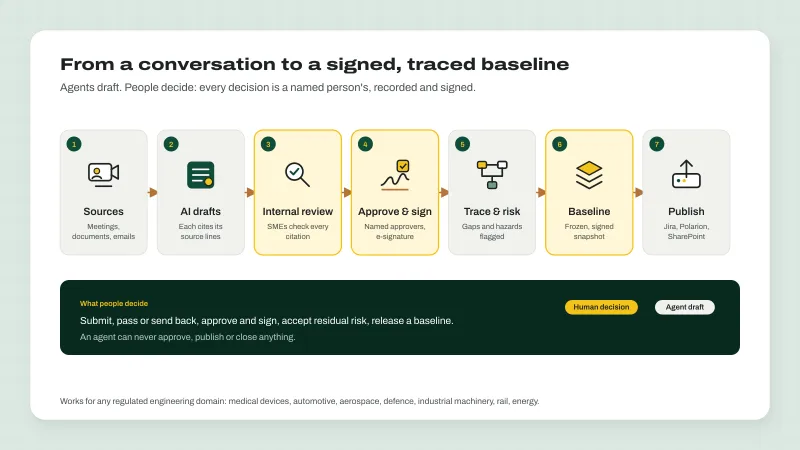
Tracewright is design controls and traceability for regulated engineering teams. It takes what your team already produces, from design reviews and client meetings to specifications and emails, and drafts requirements, decisions, actions, gaps and hazards, each citing the exact statements it came from. People stay in charge. Named experts review every draft, approvers sign with an electronic signature, and an agent never approves, publishes or closes anything. The trace matrix shows what is linked and what is missing, alerts close by themselves when the cause is fixed, and approved records are released as signed baselines to Jira, Polarion or SharePoint. Domain profiles fit medical devices, automotive, aerospace, defence, industrial machinery, rail and energy, and it runs as a managed service or on your own premises.
What it does
- AI drafts from meetings and documents, each citing its sources
- Record in the browser, with a browser extension or the desktop app
- Named reviewers, review flows and electronic signatures
- Trace matrix with gaps, alerts and release readiness
- Risk management with signed residual-risk acceptance
- Signed baselines published to Jira, Polarion or SharePoint
- Import from ReqIF or CSV, and test results from JUnit
- Works without AI; you govern providers, data classes and budgets
Used for
- Medical device design controls and design history
- Requirement traceability for automotive, aerospace and defence
- Machinery safety requirements and risk files
- Turning project meetings into decisions, actions and requirements
Key facts
What is Tracewright?
Design-controls and traceability software for regulated engineering teams. AI drafts requirements, decisions, actions, gaps and hazards from meetings and documents, each citing its sources; named people review, approve and sign.
| For | Medical devices, automotive, aerospace, defence, industrial machinery, rail and energy |
|---|---|
| Inputs | Design reviews, client meetings, specifications and emails, recorded in the browser, extension or desktop app |
| Governance | Named reviewers, review flows and electronic signatures; an agent never approves, publishes or closes |
| Traceability | Trace matrix with gaps, self-closing alerts and release readiness |
| Risk | Risk management with signed residual-risk acceptance |
| Publishes to | Jira, Polarion or SharePoint, as signed baselines |
| Imports | Requirements from ReqIF or CSV; test results from JUnit |
| AI control | Works without AI; you govern providers, data classes and budgets |
| Deployment | Managed service or on your premises |
How it works
Agents draft. People decide.
- 1
Add a source
Record or upload a meeting, a document or an email, with consent kept alongside.
- 2
Drafts appear
Requirements, decisions, actions, gaps and hazards, each citing the statements it came from.
- 3
Experts review
Named SMEs check every citation, fix wording in new revisions and pass or send back.
- 4
Approvers sign
Electronic signatures with their meaning; the approval matrix decides who and in what order.
- 5
Trace and release
Gaps and alerts until it's complete; then a signed baseline goes to Jira, Polarion or SharePoint.
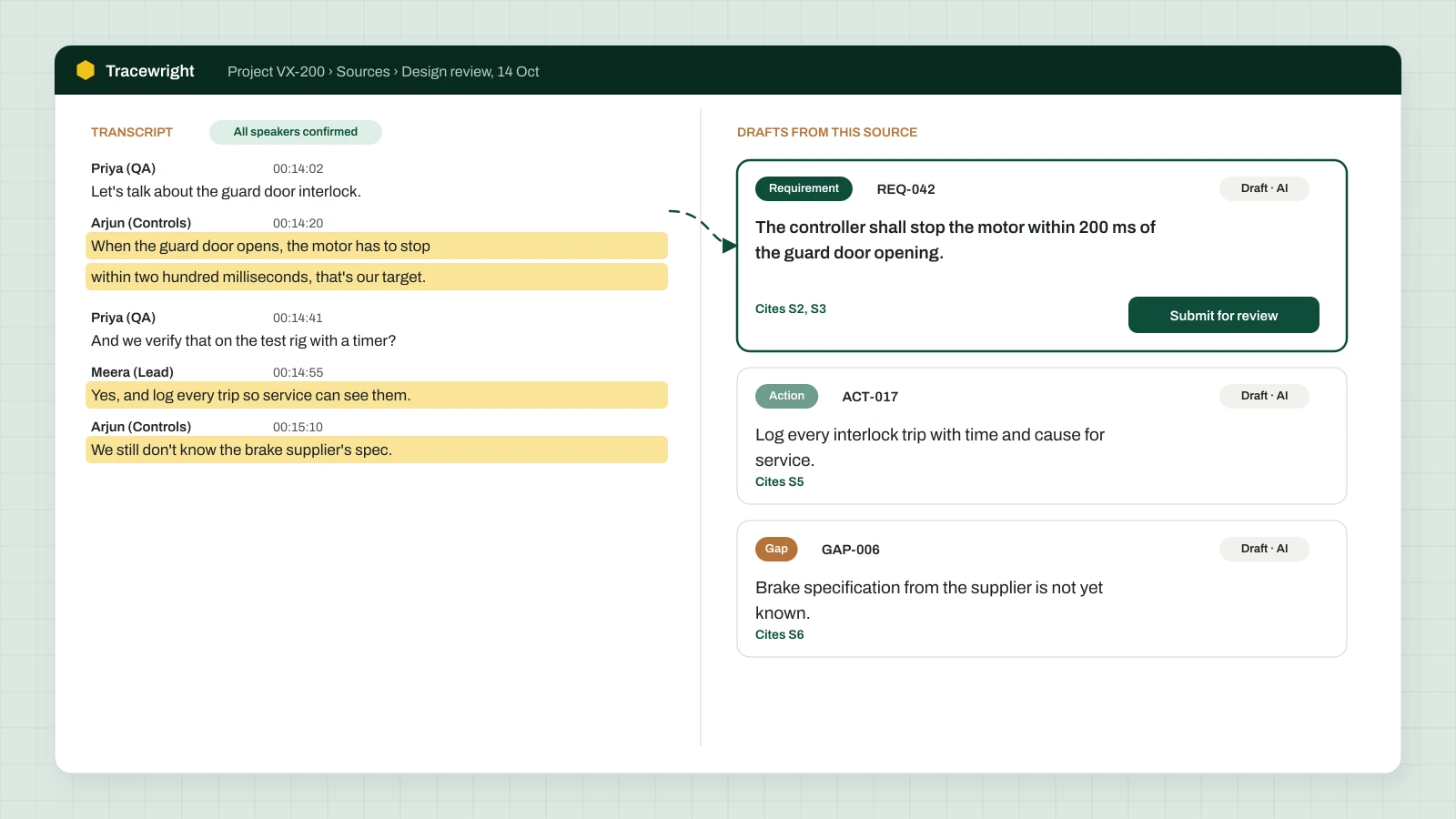
A closer look
What your team works with
Illustrations of the main screens, with made-up project content.
Help & docs
Set it up, move to it, fix it
Guides written by the team that builds and supports Tracewright.
All Tracewright docs →- Get startedWhat Tracewright doesMeetings and documents become draft requirements, decisions, gaps and hazards, each traced to its source, then reviewed, signed and released as a baseline. Agents draft; people decide.
- Get startedQuick start: your first projectStart a design project in six steps, add your first meeting or document, and review the drafts it produces.
- Get startedRoles and who can do whatApp roles, project duties, and the separation of duties that keeps reviews honest.
- UseAdd meetings, documents and emailsEvery way to bring a source into a project, and how retention and consent work.
- UseRecord meetingsRecord in the browser, with the browser extension or the desktop app; file the recording, confirm who spoke and get drafts.
- UseReview and approve records, day to dayA reviewer's and approver's routine, from My queue to the signature, with the approval package.
Sign up
Sign up for Tracewright
Start with Meetings, or the full design controls. Tell us your domain and the tools you use, and we'll set up a workspace or walk you through it with your own project.
Read the docsTell us who you are and what you'll use it for. We'll set up your access and send you the details.
Questions
Tracewright: questions buyers ask
What is Tracewright?
Tracewright is design-controls and traceability software for regulated engineering teams. It turns what teams already produce (design reviews, client meetings, specifications and emails) into drafted requirements, decisions, actions, gaps and hazards, each citing the exact statements it came from. People review, approve and sign; an agent never approves, publishes or closes anything.
Which industries is Tracewright for?
Engineering teams with traceability obligations: medical devices, automotive, aerospace, defence, industrial machinery, rail and energy. Each has a domain profile.
Does Tracewright replace Jira or Polarion?
No. Tracewright drafts and governs the records, then releases approved records as signed baselines to Jira, Polarion or SharePoint, so your existing tools stay the system your teams work in.
Does AI approve anything in Tracewright?
No. AI drafts; named experts review every draft and approvers sign with an electronic signature. Tracewright also works without AI, and you govern which AI providers, data classes and budgets are allowed.
What does the trace matrix show?
What is linked and what is missing between requirements, risks, tests and decisions, with alerts that close by themselves when the cause is fixed, and a release-readiness view.
Can we import existing requirements and test results?
Yes. Requirements import from ReqIF or CSV, and test results import from JUnit.
Can Tracewright run on our premises?
Yes. It runs as a managed service or on your own premises.
Who makes Tracewright?
Tracewright is part of ThingsX by Intellobots, designed, engineered and supported by Intellobots Technologies Pvt Ltd in Hyderabad, India.
How much does Tracewright cost?
There is no public price list, because the cost depends on scope. Book a 30-minute call or use the quote form; you get a written estimate, usually starting with a small pilot so you can see results before a larger commitment.
Do you work with companies outside Hyderabad?
Intellobots is based in Jubilee Hills, Hyderabad, and works with clients across India (including Mumbai, Delhi NCR, Bengaluru, Chennai, Visakhapatnam and Vijayawada) and in the US, Europe and the Middle East. Engineering and support are run from Hyderabad; site work is planned with you for each location.